Market overviews

Dec 16, 2025

Batch Testing: YC 2021 Cohort

Batch Testing: YC 2021 Cohort

YC 2021 Batch
YC 2021 Batch
YC 2021 Batch

Copy link

Copied

Copy link

Copied

Copy link

Copied


Welcome to the second edition of our Batch Testing series, where we track how every YC cohort has performed post-YC. We began with the
YC 2020 batch, tracking growth trajectories and key metrics to assess how the startups performed over five years. This time, we’re breaking down YC 2021 outcomes four years later.

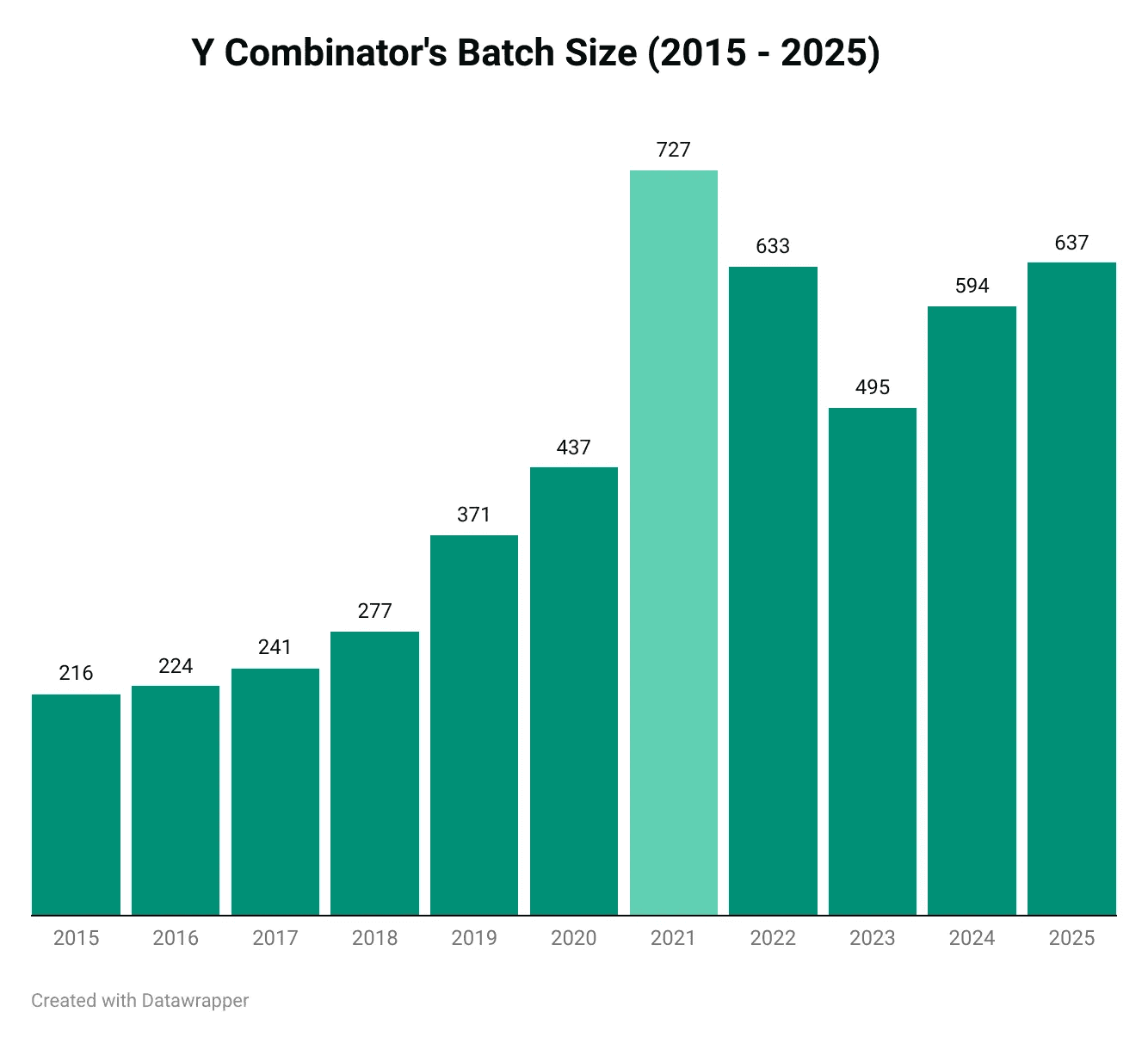
Y Combinator funded a record 727 startups in 2021 across its Winter and Summer batches, marking its largest year ever.

YC batch size from 2015 to 2025


By 2021, pandemic uncertainty had given way to a funding frenzy. Instacart hit $39B, Tiger Global wrote checks in 48 hours, and SPACs flooded the market. YC also went all in.

The Winter 2021 batch included 350 startups, and the Summer batch grew to 402. While Demo Days remained virtual, 3,000+ investors still showed up, unlocking record seed funding.

A total of 47 countries were represented across both batches. And for the first time in YC’s history, about ~50% of the startups in the cohort were based outside the US. The top non-US countries included India (33 companies), the UK (18), Canada (18), Mexico (17), Singapore (12), and Brazil (11).

Four years later, we're measuring whether that conviction paid off.

Let’s rewind to 2021.


The Bets

B2B SaaS, Fintech, and Consumer startups have historically driven YC's biggest outcomes (Stripe, Airbnb, Coinbase), and 2021 showed continued concentration here.

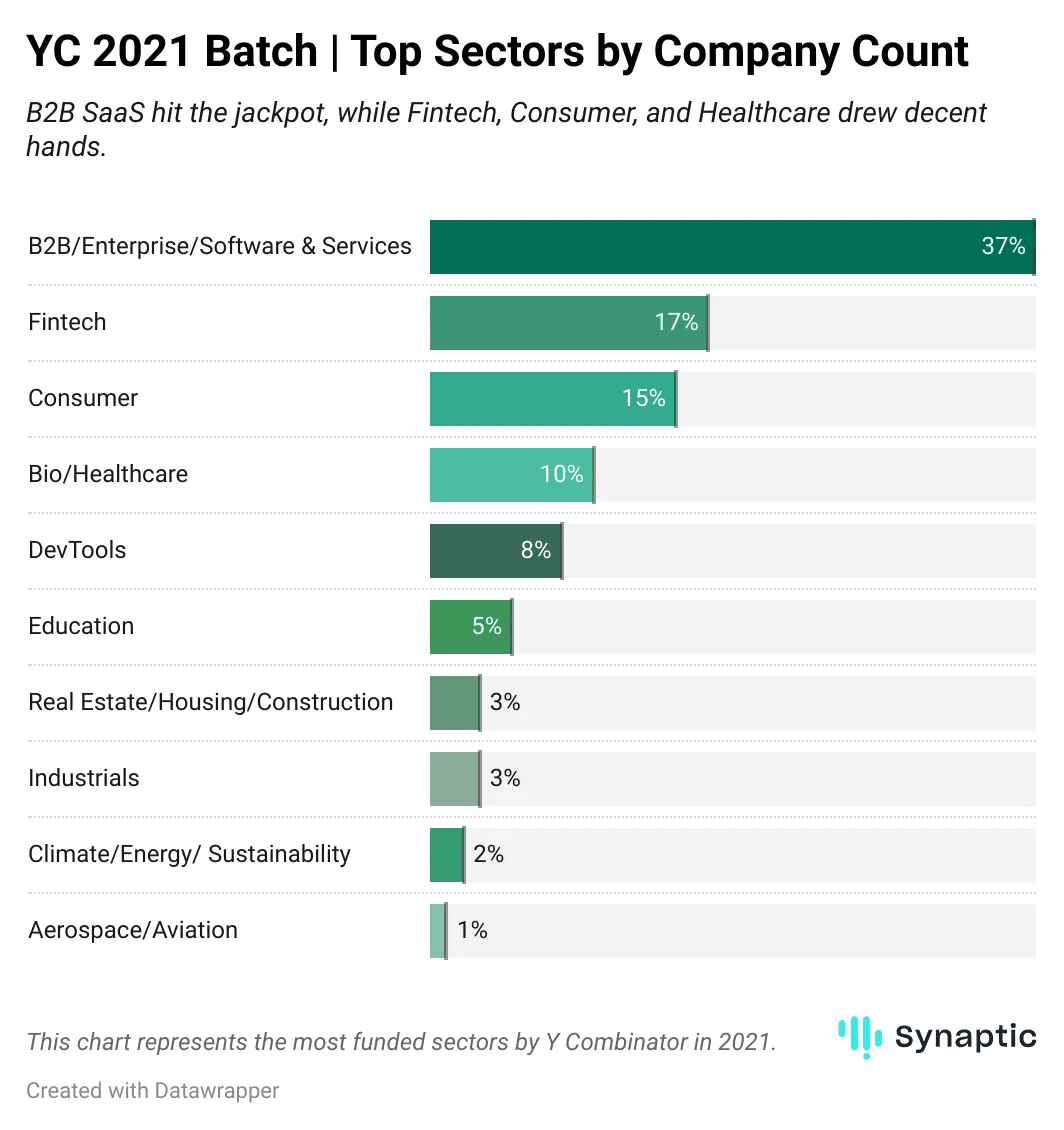
B2B Software remained a top category, but its share fell from 45% in 2020 to 37% in 2021.
This suggests YC broadened its intake beyond core SaaS, even while keeping B2B as the backbone of the cohort.

Top sectors funded by YC in 2021


Consumer held steady at 14-15% across both years.

It ranked third in 2020 and 2021, showing consistent interest in consumer products.

Healthcare declined from 15% in 2020 to 10% in 2021.
It was the second most funded sector in 2020, but only came in fourth in 2021, indicating a relative cooling in YC’s healthcare intake year over year.

DevTools emerged as a notable category in 2021 at 8%.
This shows YC’s growing emphasis on developer-first and infra tooling, likely influenced by cloud, AI, and remote-first software trends at the time.

Capital-intensive sectors attracted minimal interest.
Aerospace/Aviation (1%), Climate/Energy/Sustainability (2%), and Industrials (3%) combined for just 6% of the batch, reflecting YC's historical focus on software and digital products.

To get a more detailed view, we can further break down the categories into specific verticals that got the most funding.

Sub Category

Percentage

Engineering, Product, and Design

7.8%

Marketplace

4.8%

Consumer Health and Wellness

4.5%

Ecommerce

3.8%

E-learning

3.5%

Analytics

3.3%

Human Resources

3.3%

Productivity

3.0%

Consumer Finance

2.8%

Operations

2.8%

Finance and Accounting

2.8%

Security

2.5%

Artificial Intelligence

1.5%


What's interesting to note here is the share of AI startups. It represented just 1.5% of the YC 2021 batch. By 2025, AI agents alone made up 46% of YC's Spring batch, and 88% of Summer startups were AI-native. This shows how quickly the sector has exploded in just 4 years!!


Welcome to the second edition of our Batch Testing series, where we track how every YC cohort has performed post-YC. We began with the
YC 2020 batch, tracking growth trajectories and key metrics to assess how the startups performed over five years. This time, we’re breaking down YC 2021 outcomes four years later.

Y Combinator funded a record 727 startups in 2021 across its Winter and Summer batches, marking its largest year ever.

YC batch size from 2015 to 2025


By 2021, pandemic uncertainty had given way to a funding frenzy. Instacart hit $39B, Tiger Global wrote checks in 48 hours, and SPACs flooded the market. YC also went all in.

The Winter 2021 batch included 350 startups, and the Summer batch grew to 402. While Demo Days remained virtual, 3,000+ investors still showed up, unlocking record seed funding.

A total of 47 countries were represented across both batches. And for the first time in YC’s history, about ~50% of the startups in the cohort were based outside the US. The top non-US countries included India (33 companies), the UK (18), Canada (18), Mexico (17), Singapore (12), and Brazil (11).

Four years later, we're measuring whether that conviction paid off.

Let’s rewind to 2021.


The Bets

B2B SaaS, Fintech, and Consumer startups have historically driven YC's biggest outcomes (Stripe, Airbnb, Coinbase), and 2021 showed continued concentration here.

B2B Software remained a top category, but its share fell from 45% in 2020 to 37% in 2021.
This suggests YC broadened its intake beyond core SaaS, even while keeping B2B as the backbone of the cohort.

Top sectors funded by YC in 2021


Consumer held steady at 14-15% across both years.

It ranked third in 2020 and 2021, showing consistent interest in consumer products.

Healthcare declined from 15% in 2020 to 10% in 2021.
It was the second most funded sector in 2020, but only came in fourth in 2021, indicating a relative cooling in YC’s healthcare intake year over year.

DevTools emerged as a notable category in 2021 at 8%.
This shows YC’s growing emphasis on developer-first and infra tooling, likely influenced by cloud, AI, and remote-first software trends at the time.

Capital-intensive sectors attracted minimal interest.
Aerospace/Aviation (1%), Climate/Energy/Sustainability (2%), and Industrials (3%) combined for just 6% of the batch, reflecting YC's historical focus on software and digital products.

To get a more detailed view, we can further break down the categories into specific verticals that got the most funding.

Sub Category

Percentage

Engineering, Product, and Design

7.8%

Marketplace

4.8%

Consumer Health and Wellness

4.5%

Ecommerce

3.8%

E-learning

3.5%

Analytics

3.3%

Human Resources

3.3%

Productivity

3.0%

Consumer Finance

2.8%

Operations

2.8%

Finance and Accounting

2.8%

Security

2.5%

Artificial Intelligence

1.5%


What's interesting to note here is the share of AI startups. It represented just 1.5% of the YC 2021 batch. By 2025, AI agents alone made up 46% of YC's Spring batch, and 88% of Summer startups were AI-native. This shows how quickly the sector has exploded in just 4 years!!


Welcome to the second edition of our Batch Testing series, where we track how every YC cohort has performed post-YC. We began with the
YC 2020 batch, tracking growth trajectories and key metrics to assess how the startups performed over five years. This time, we’re breaking down YC 2021 outcomes four years later.

Y Combinator funded a record 727 startups in 2021 across its Winter and Summer batches, marking its largest year ever.

YC batch size from 2015 to 2025


By 2021, pandemic uncertainty had given way to a funding frenzy. Instacart hit $39B, Tiger Global wrote checks in 48 hours, and SPACs flooded the market. YC also went all in.

The Winter 2021 batch included 350 startups, and the Summer batch grew to 402. While Demo Days remained virtual, 3,000+ investors still showed up, unlocking record seed funding.

A total of 47 countries were represented across both batches. And for the first time in YC’s history, about ~50% of the startups in the cohort were based outside the US. The top non-US countries included India (33 companies), the UK (18), Canada (18), Mexico (17), Singapore (12), and Brazil (11).

Four years later, we're measuring whether that conviction paid off.

Let’s rewind to 2021.


The Bets

B2B SaaS, Fintech, and Consumer startups have historically driven YC's biggest outcomes (Stripe, Airbnb, Coinbase), and 2021 showed continued concentration here.

B2B Software remained a top category, but its share fell from 45% in 2020 to 37% in 2021.
This suggests YC broadened its intake beyond core SaaS, even while keeping B2B as the backbone of the cohort.

Top sectors funded by YC in 2021


Consumer held steady at 14-15% across both years.

It ranked third in 2020 and 2021, showing consistent interest in consumer products.

Healthcare declined from 15% in 2020 to 10% in 2021.
It was the second most funded sector in 2020, but only came in fourth in 2021, indicating a relative cooling in YC’s healthcare intake year over year.

DevTools emerged as a notable category in 2021 at 8%.
This shows YC’s growing emphasis on developer-first and infra tooling, likely influenced by cloud, AI, and remote-first software trends at the time.

Capital-intensive sectors attracted minimal interest.
Aerospace/Aviation (1%), Climate/Energy/Sustainability (2%), and Industrials (3%) combined for just 6% of the batch, reflecting YC's historical focus on software and digital products.

To get a more detailed view, we can further break down the categories into specific verticals that got the most funding.

Sub Category

Percentage

Engineering, Product, and Design

7.8%

Marketplace

4.8%

Consumer Health and Wellness

4.5%

Ecommerce

3.8%

E-learning

3.5%

Analytics

3.3%

Human Resources

3.3%

Productivity

3.0%

Consumer Finance

2.8%

Operations

2.8%

Finance and Accounting

2.8%

Security

2.5%

Artificial Intelligence

1.5%


What's interesting to note here is the share of AI startups. It represented just 1.5% of the YC 2021 batch. By 2025, AI agents alone made up 46% of YC's Spring batch, and 88% of Summer startups were AI-native. This shows how quickly the sector has exploded in just 4 years!!

The Scorecard

74% of startups (535) remain active four years later, while 11% (81) have already been acquired. Historically, 25% to 50% of YC startups are acquired over a 10-year horizon, indicating the cohort is still early in its exit cycle.
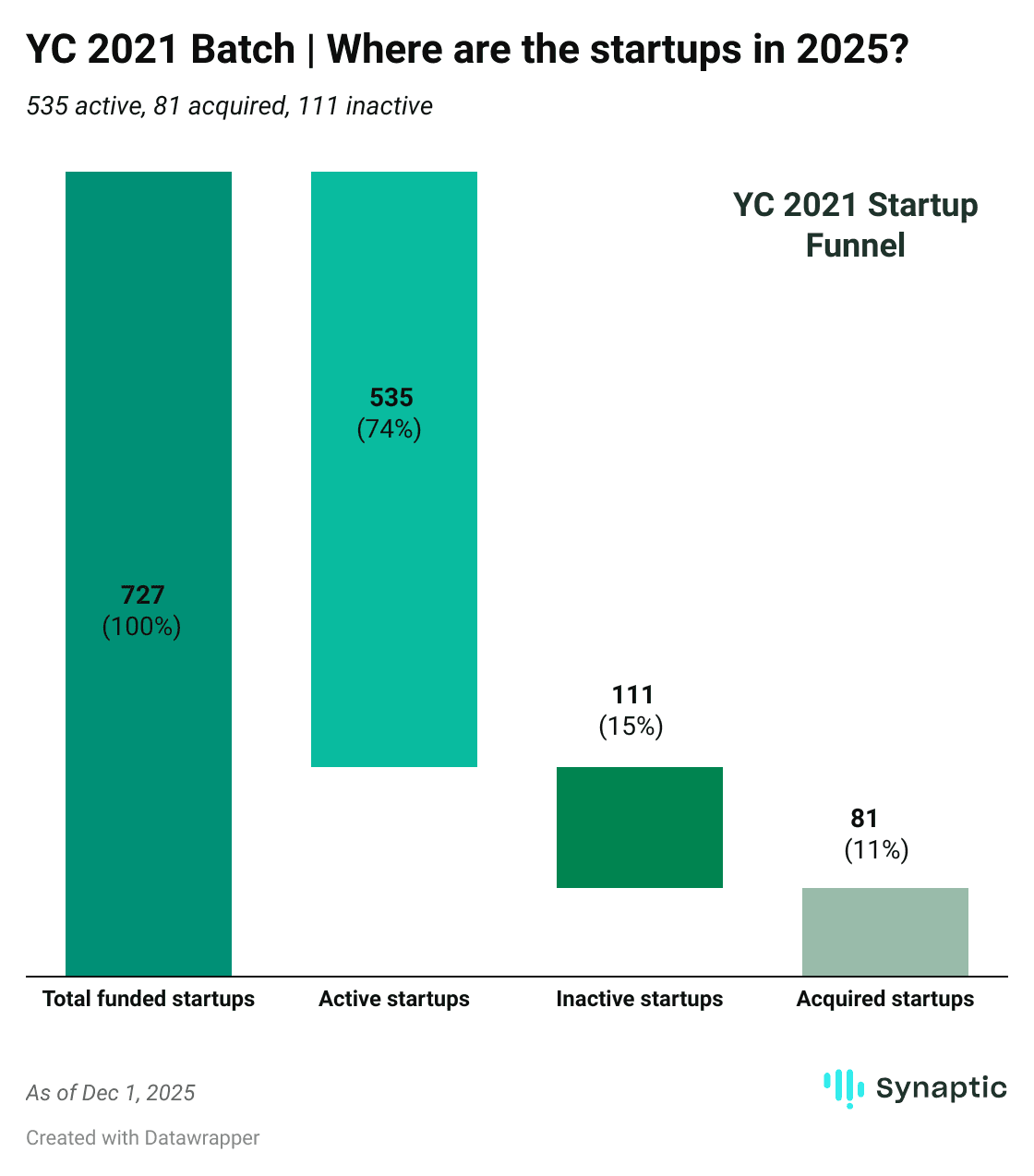
YC 2021 startup funnel


  • ~4 Unicorns created: Zepto ($7B), Stokes Space ($2B), Onebrief ($1.1B), Nourish ($1B)

  • ~84% Success Rate as of now: 612 startups are still active or acquired

  • ~19% Reached Series A+ in four years: 138 startups hit institutional funding milestones post-YC

The 2020 batch clocked in 80% survival rate after five years (276 active + 72 acquired), while the 2021 batch hit 85% after four years (535 active + 81 acquired). Despite being larger and younger, the 2021 cohort shows slightly stronger early survival.

Despite higher survival, fewer YC 2021 startups advanced to Series A+.
The rate dropped from ~33% in 2020 to ~19% in 2021, despite the 2021 batch being 66% larger (727 vs 437 startups). However, 2020 had 5 years to mature, and market timing differs: the 2021 cohort launched during peak funding but hit the 2022-2023 correction shortly after.


Want the full breakdown?
Download the complete YC 2021 performance dataset here.

Alma Matters: Where Founders Came From

Half of the YC 2021 founders were based in the US, while the other half came from abroad, highlighting YC's expanding global reach.


YC 2021 founders were seasoned professionals with advanced degrees.
53% of founders held advanced degrees and brought 9 years of experience on average. In comparison, YC 2020 attracted founders with 8 years of experience on average, and about 40% held advanced degrees (MBAs, PhDs, Master's).


The 24-34 age range remained the same. However, the 2021 batch featured founders with stronger technical and business credentials.

Around ~48% came from CS or engineering backgrounds, while business, economics, and other analytical fields made up the remainder.
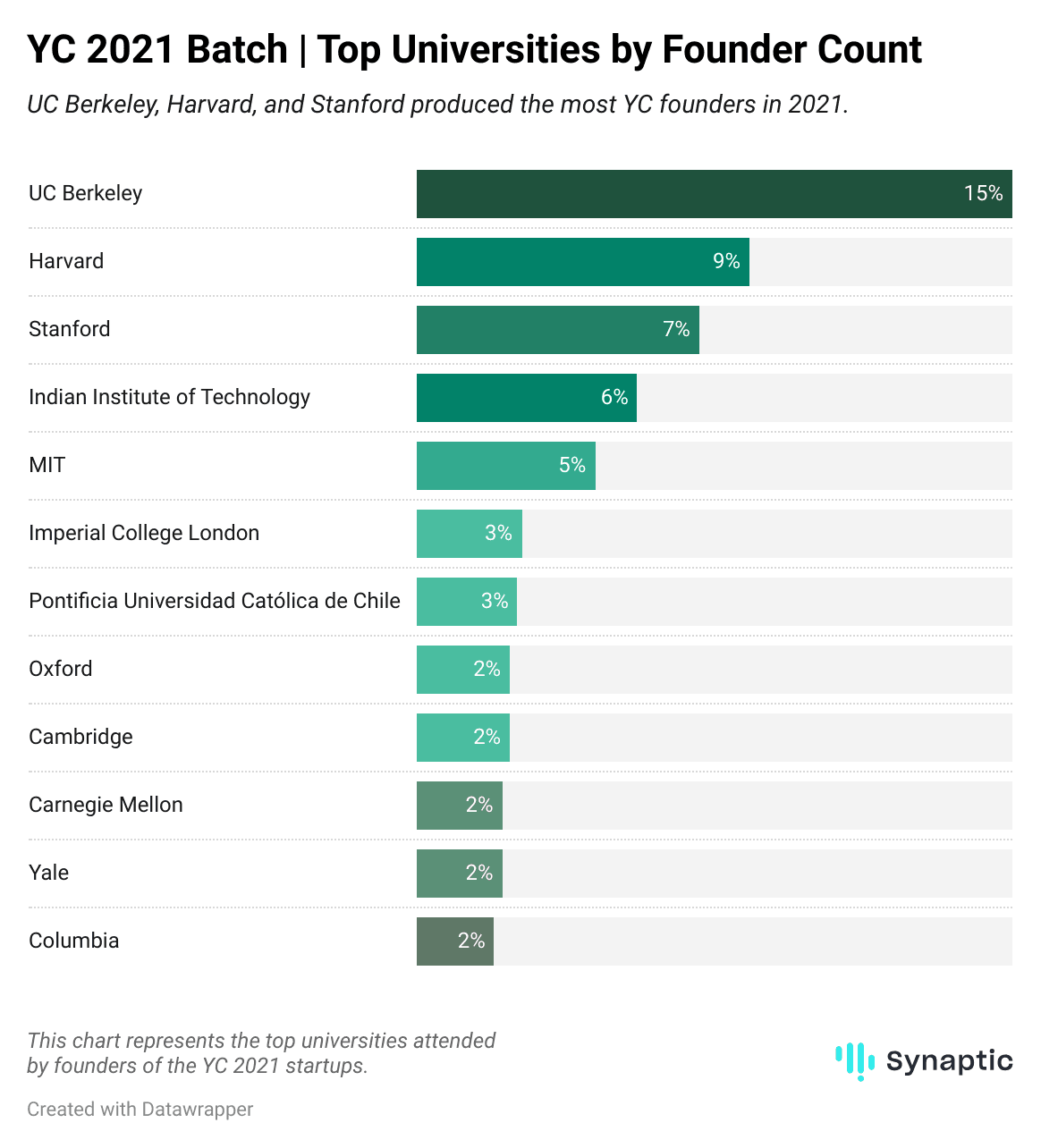
Top universities attended by YC 2021 founders


Similar to the 2020 batch, most of the YC 2021 founders came from elite schools.
15% of all founders came from UC Berkeley, making it the single largest talent source by a significant margin, followed by Harvard (9%) and Stanford (7%).

However, only 3 non-US institutions (IIT, Imperial, Pontificia) broke into the rankings, showing YC's founder pool skews towards the US despite its global applicant base.

The Four-Year Journey: Capital Raised, Value Created

Zepto raised $2.6B, more than double any other YC 2021 startup.
Stoke Space follows at $1B, while Slope ($252M), Tractian ($184M), and F2 Capital ($180M) round out the top five.
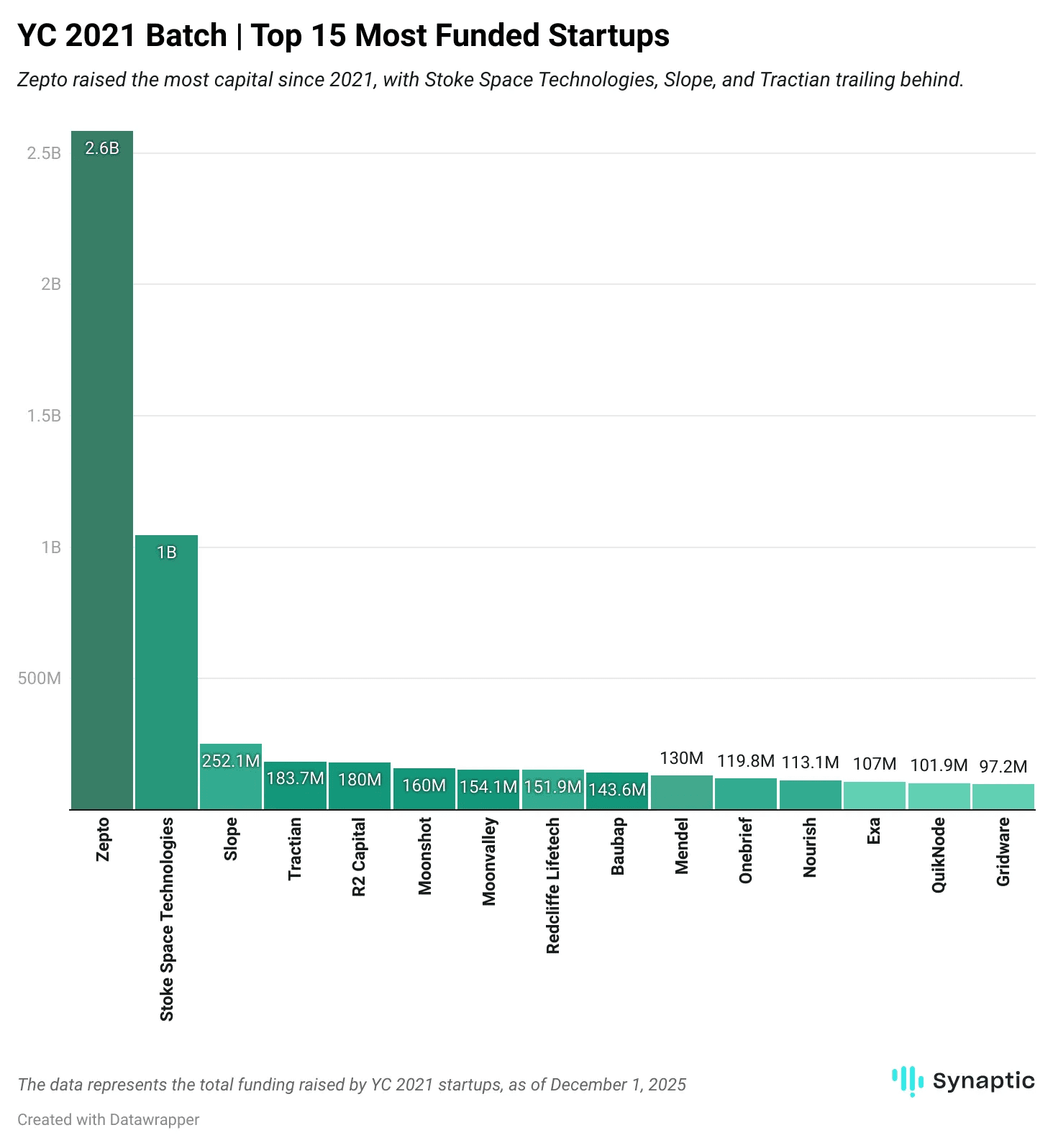
Top 15 most funded startups from the YC 2021 batch


Despite high survival, only three companies broke past the $200M mark.
The majority cluster tightly between $100M and $180M, suggesting only a few startups have secured large late-stage rounds. The third-largest company, Slope, has raised ~$252M, highlighting a cliff between breakout winners and the rest of the cohort.

In comparison, 2020 produced multiple large fundraisers: WhatNot ($749.7M), Supabase ($496.1M), Jeeves ($443M), Balance ($431M). Capital was also more evenly distributed across the top performers, with several companies approaching the half-billion mark rather than one big player.

Breakout Stars

Apart from Zepto and Stoke Space, few startups managed to make a big splash in 2025. However, the cohort did produce some notable startups across sectors.

  • India's Quick-Commerce Unicorn: Zepto
    Quick-commerce company delivering groceries in 10 minutes across 35+ Indian cities. Raised $2.3B total to reach $7B valuation, with $450M pre-IPO round from CalPERS in October 2025. With 75% of stores being EBITDA positive, Zepto is approaching profitability ahead of public listing.

  • Next-Gen Rocket Company: Stoke Space
    Building the first fully reusable rocket with both stages returning to Earth. Raised $510M Series D led by Thomas Tull's USIT fund. Won US Space Force NSSL contract and reactivating Cape Canaveral's historic Launch Complex 14.

  • Predictive Maintenance Leader: Tractian
    Industrial predictive maintenance using AI-powered IoT sensors to prevent machine failures. Brazil's top-funded AI company, serving manufacturers from SMBs to enterprises. Secured $120M in Series C funding led by Sapphire Ventures.

  • Fortune 500 Payment Platform: Slope
    AI-powered B2B payments platform automating order-to-cash for Fortune 500 companies. Raised $252M total ($77M equity + $175M debt), including $65M from JP Morgan. Joined JP Morgan Payments Partner Network to digitise the $125T B2B payments economy through embedded financing and checkout solutions.

  • Military-Grade Satellite Imagery: Albedo
    VLEO satellite platform delivering 10cm resolution imagery previously only available from classified military satellites. Raised $97M+ and launched the first satellite, Clarity-1, in March 2025. Pivoted to selling VLEO satellite buses after proving technology.

  • AWS of Blockchain: QuickNode
    Blockchain infrastructure powering 16+ chains, including Ethereum, Solana, and Bitcoin. Raised $60M in a Series B round led by 10T to reach $800M valuation. Became the "AWS of blockchain" by providing APIs, tools, and managed nodes for Web3 developers scaling from prototype to production.

Breakout Stars

Apart from Zepto and Stoke Space, few startups managed to make a big splash in 2025. However, the cohort did produce some notable startups across sectors.

  • India's Quick-Commerce Unicorn: Zepto
    Quick-commerce company delivering groceries in 10 minutes across 35+ Indian cities. Raised $2.3B total to reach $7B valuation, with $450M pre-IPO round from CalPERS in October 2025. With 75% of stores being EBITDA positive, Zepto is approaching profitability ahead of public listing.

  • Next-Gen Rocket Company: Stoke Space
    Building the first fully reusable rocket with both stages returning to Earth. Raised $510M Series D led by Thomas Tull's USIT fund. Won US Space Force NSSL contract and reactivating Cape Canaveral's historic Launch Complex 14.

  • Predictive Maintenance Leader: Tractian
    Industrial predictive maintenance using AI-powered IoT sensors to prevent machine failures. Brazil's top-funded AI company, serving manufacturers from SMBs to enterprises. Secured $120M in Series C funding led by Sapphire Ventures.

  • Fortune 500 Payment Platform: Slope
    AI-powered B2B payments platform automating order-to-cash for Fortune 500 companies. Raised $252M total ($77M equity + $175M debt), including $65M from JP Morgan. Joined JP Morgan Payments Partner Network to digitise the $125T B2B payments economy through embedded financing and checkout solutions.

  • Military-Grade Satellite Imagery: Albedo
    VLEO satellite platform delivering 10cm resolution imagery previously only available from classified military satellites. Raised $97M+ and launched the first satellite, Clarity-1, in March 2025. Pivoted to selling VLEO satellite buses after proving technology.

  • AWS of Blockchain: QuickNode
    Blockchain infrastructure powering 16+ chains, including Ethereum, Solana, and Bitcoin. Raised $60M in a Series B round led by 10T to reach $800M valuation. Became the "AWS of blockchain" by providing APIs, tools, and managed nodes for Web3 developers scaling from prototype to production.

Breakout Stars

Apart from Zepto and Stoke Space, few startups managed to make a big splash in 2025. However, the cohort did produce some notable startups across sectors.

  • India's Quick-Commerce Unicorn: Zepto
    Quick-commerce company delivering groceries in 10 minutes across 35+ Indian cities. Raised $2.3B total to reach $7B valuation, with $450M pre-IPO round from CalPERS in October 2025. With 75% of stores being EBITDA positive, Zepto is approaching profitability ahead of public listing.

  • Next-Gen Rocket Company: Stoke Space
    Building the first fully reusable rocket with both stages returning to Earth. Raised $510M Series D led by Thomas Tull's USIT fund. Won US Space Force NSSL contract and reactivating Cape Canaveral's historic Launch Complex 14.

  • Predictive Maintenance Leader: Tractian
    Industrial predictive maintenance using AI-powered IoT sensors to prevent machine failures. Brazil's top-funded AI company, serving manufacturers from SMBs to enterprises. Secured $120M in Series C funding led by Sapphire Ventures.

  • Fortune 500 Payment Platform: Slope
    AI-powered B2B payments platform automating order-to-cash for Fortune 500 companies. Raised $252M total ($77M equity + $175M debt), including $65M from JP Morgan. Joined JP Morgan Payments Partner Network to digitise the $125T B2B payments economy through embedded financing and checkout solutions.

  • Military-Grade Satellite Imagery: Albedo
    VLEO satellite platform delivering 10cm resolution imagery previously only available from classified military satellites. Raised $97M+ and launched the first satellite, Clarity-1, in March 2025. Pivoted to selling VLEO satellite buses after proving technology.

  • AWS of Blockchain: QuickNode
    Blockchain infrastructure powering 16+ chains, including Ethereum, Solana, and Bitcoin. Raised $60M in a Series B round led by 10T to reach $800M valuation. Became the "AWS of blockchain" by providing APIs, tools, and managed nodes for Web3 developers scaling from prototype to production.

The YC 2021 Batch: Where are they now?

Leading the charge is Zepto, which is heading to the public markets with a $7 billion valuation. It is one of India's fastest-growing companies to IPO.

Stoke Space ($2B), Onebrief ($1.1B), and Nourish ($1B) have also hit unicorn status, marking four billion-dollar outcomes so far. However, four years later, only a few companies are carrying the upside, while most are still early-stage.

Name

Website

Status

Category

Location

Total Funding Amount

Last Known Valuation

Synaptic Growth Index (Dec 25)

Zepto

zepto.com

Active

Consumer

India

2.58B

7B

Rapid Growth

Stoke Space

stokespace.com

Active

Industrials

United States

1.05B

2B

Fast Growth

Slope

slopepay.com

Active

Fintech

United States

252.1M

Not publicly disclosed

Flat

Tractian

tractian.com

Active

Industrials

United States

183.7M

720M

Fast Growth

R2

r2.co

Acquired

Fintech

Mexico

180.0M

100M


Moonshot Brands

moonshotbrands.com

Acquired

Fintech

United States

160.0M

Not publicly disclosed

Flat

Moonvalley

moonvalley.com

Active

Consumer

Canada

154.1M

Not publicly disclosed

Flat

Redcliffe Lifetech

redcliffelabs.com

Active

Healthcare

India

151.9M

Not publicly disclosed

Steady Growth

Baubap

baubap.com

Active

Fintech

Mexico

143.6M

1.1M

Flat

Mendel

somosmendel.com

Active

Fintech

Mexico

130.0M

Not publicly disclosed

Steady Growth

Onebrief

onebrief.com

Active

B2B

United States

119.8M

1.1B

Fast Growth

Nourish

usenourish.com

Active

Healthcare

United States

113.1M

1B

Fast Growth

Exa

exa.ai

Active

B2B

United States

107.0M

700M

Steady Growth

QuickNode

quicknode.com

Active

B2B

United States

101.9M

800M

Flat

Gridware

gridware.io

Active

Industrials

United States

97.2M

Not publicly disclosed

Steady Growth

You've seen 15. See all 727.

Explore the full 2021 batch to uncover metrics like total funding, valuation, headcount, GitHub traction, and more across all 727 startups.

Perfect for VCs benchmarking portfolios, founders researching comparable trajectories, or anyone tracking YC outcomes.


[Download the complete database here]

Enjoyed the analysis? Get the next one delivered to your inbox.